Thursday, August 25, 2016

A Communion Hymn Meditation: How Sweet and Aweful is the Place


In a few moments we’re going to sing together a favorite Isaac Watts hymn “How Sweet and Aweful is the Place.  It’s a hymn about this great parable –
He opens the first verse by describing the great and admire-able feast of Christ’s Kingdom – It is a feast that is sweet and full of awe … and one that displays the choicest foods from His stores.
And when we join together for that great feast, from our hearts, we will cry out to the Lord – “Why am I a guest?  Why did I hear Your voice inviting me here when so many others choose to starve outside?”
Watts gives us the correct answer.  The Lord replies – “The same sweet love that spread this feast drew you here.  Without it, you also would have refused and perished.”
So Watts finishes the hymn with a prayer for us to sing together.
And it is the application of this Kingdom parable.
After confessing that the only reason we’ve been invited into the Kingdom feast was the sweetness of God’s love toward us, we pray and ask Him to have compassion on the nations and to extend the call of His sweet love to all the earth.  We ask Him to constrain or draw strangers to their true home and to make His Word victorious, that it would triumph in our world.
The fact that unworthies such as we have been invited to Christ’s great banquet-feast fills us with longing to see all of His churches filled with people to join us in singing from our hearts with one voice the hymn of His redeeming grace.
Why did Israel receive the immeasurable blessings of the Covenant?  Why have we received the priceless blessings of the Kingdom?
Not because we earned it.  Not because God knew He’d get a good return on His investment.  In fact, as we’ll see – God-willing – later this season when we get to Lk 17, when we have done all we can, we will still have failed to return God any profit for what He spent on us.

By inviting us to His feast, Christ has been gracious to those who can never repay Him, just as He has called us to do.  And so the Father has exalted Him and will yet still reward Him at the consummation of all things – the resurrection of the just and the wedding feast of the Lamb.

Monday, May 30, 2016

Francis Schaeffer on Punk Rock


"Why does human life have any value at all?  Not only are you going to die individually, but the whole human race is going to die.  Someday the world will grow too hot or cold and all you people will not only be individually dead, but the whole conscious life on this world will be dead and nobody will see the birds fly.  As you know, I don't speak academically, shut off in a scholastic cubicle.  I have lots of young people come to us from the end of the earth.  And they have gone to the end of this logically.  They realize what the situation is.  They can't find any meaning to life.  It's the meaning of the words "punk rock".  I must say that on the basis of what they're being taught in schools, that the final reality is only this material thing - they're not wrong; they're right."

- Francis Schaeffer

Saturday, April 2, 2016

What does Baptism Mean?


1 Corinthians 12 talks about the kind of body that the Church is.  And the kind of body that the Church is is the kind of body where the weakest members - the members who are least honorable - are afforded and given more abundant honor.  That's the kind of community the Church is.  And every Christian wants the Church to be that kind of community that honors the weak.  The question is: does our practice of baptism actually express that?  Or does the practice of baptism imply that only the strong need apply?  Does the practice of baptism imply that the weak need to get stronger before they get in?  Or are we saying that the weak in their weakness are incorporated into this body that is the body of Christ?

- Peter Leithart

Tuesday, January 26, 2016

Epiphany Prayer


Gracious Father,
Your Son is the desire of every nation. To Those who hunger for love, He is the Bridegroom rising like the morning sun;
To those who yearn for economic prosperity, He is the Creator who turns water to an overflow of finest wine;
To those in search of justice and righteousness, He is the King who brings the incomplete cleansing of the Law to its glorious fulfillment in grace;
To those who long for sacred purpose and devotion, He is the God Who calls many and when they have sacrificed all to come, He provides for them lavishly especially in the times when it appears that they have given up so much just to arrive at a dead 
end.
For those who long for social equity, He is the Lord Who blesses rulers and masters by drawing their servants closest to Himself, so that they are the only ones given to 
see His miracle as it is performed.
O Christ, You are the joy of man’s desiring; the One for Whom our hearts always 
hunger.
Even our sinful desires are just twisted impressions of the God-shaped void within us. And our hearts are always restless until they find their rest in You.
So shine the light of Your face upon us and bless us to draw us under the shadow of Your wing.
Set our feet to walk on Your path in Your steps, Lord Jesus, and fill us in our emptiness with your Holy Spirit. 
Amen.

Friday, January 22, 2016

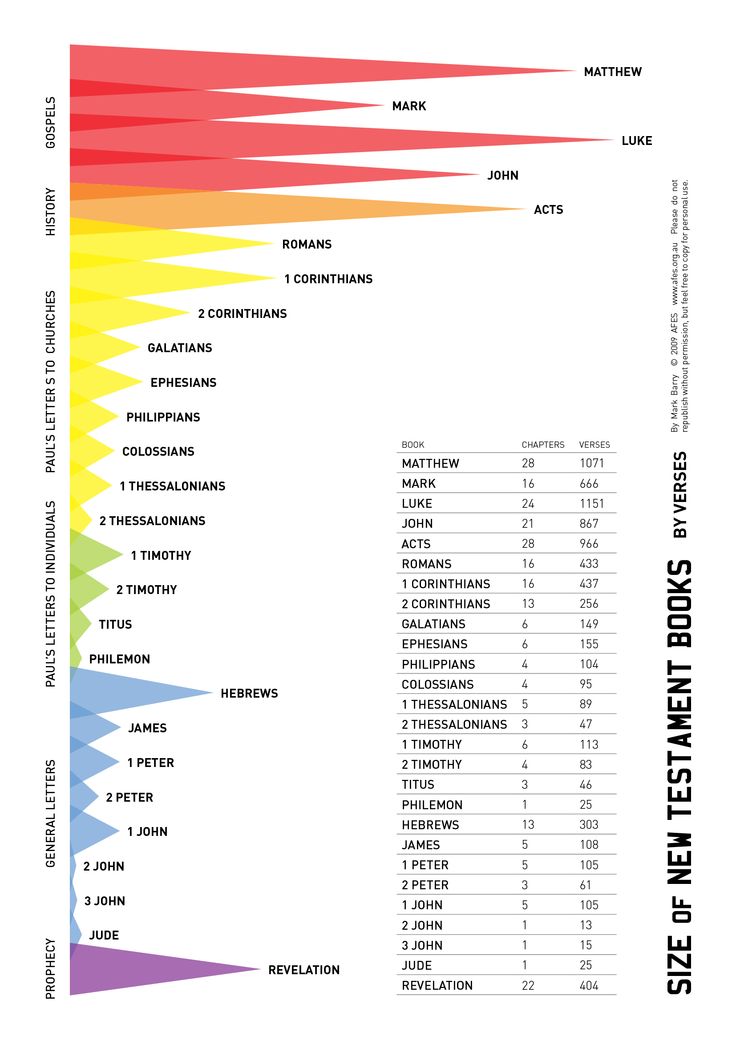
Visualizing the New Testament

Some helpful graphics when studying or memorizing from the New Testament as a whole.  The second breaks down each book by word count.  The third by verse.  The fourth by recitation or reading time [very approximate] from Andy Naselli's very fine DG article here.  The last a chapter/verse/word chart [for the Greek NT].  I especially like the third.  If you look at it sideways, each book appears like a mountain peak in comparison of height. Which will you attempt to scale next?


Wednesday, January 13, 2016

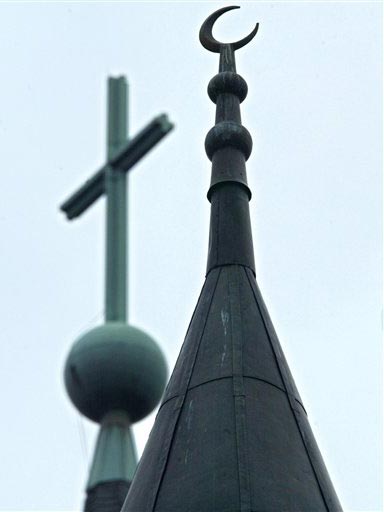
Islam: Mirror of Christendom


An abridged essay by Dr Peter J Leithart; the full essay is available here.

For if anyone is a hearer of the word and not a doer, he is like a man who looks at his natural face in a mirror; for once he has looked at himself and gone away, he has immediately forgotten what kind of person he was.”
—The Epistle of James, 1:23-24

Deep in the pit of hell, the pilgrim Dante came across Mohammed, walking with his torso split open from chin to groin.  The surprise in this scene is not the gruesomeness of Mohammed’s punishment, but the place where this scene occurs: the ninth Bolgia of Malebolgia, in the subcircle of hell reserved for schismatics. Mohammed is not among the idolaters or the pagans, but among sinners being punished for breaking off from the Christian Church, all of whom, appropriately enough, have their bodies rent as retribution for rending the body of Christ.
In treating Mohammed as a Christian schismatic, Dante was not inventing a new perspective (he rarely did), but presenting views widespread in his time. Many in the Western medieval world believed that Mohammed himself had apostatized from Christianity.  Centuries before Dante, John of Damascus (675-749) treated Islam in the final section of his treatise de Haeresibus, calling it the “heresy of the Ishmaelites.”

Monday, January 11, 2016

Why and for Whom do we clap?


An incredible video snippet from David Gallo's TED talk "underwater astonishments", one of the top 10 most viewed TED talks of all time.

A simple question: Why did it end in spontaneous applause?  For Whom were these people clapping?  The octopus?  Gallo?  I think not.  Then for Whom? SomeOne else.

Romans 1.20.